
What Medicare Doesn't Cover (And How People Fill the Gaps)
The short answer
Original Medicare (Parts A and B) generally does not cover routine dental care, routine vision care, hearing aids, long-term custodial care, most care outside the U.S., routine foot care, cosmetic surgery, or most over-the-counter items. People typically plan around these gaps with Medicare Advantage supplemental benefits, standalone dental/vision/hearing plans, hospital indemnity coverage, and separate long-term care and final expense planning.
Medicare covers a lot - hospital stays, doctor visits, many prescription drugs, preventive care, and more. But there's a version of the story that doesn't get told enough before people turn 65: Original Medicare has real gaps, and knowing them ahead of time is a lot better than finding out at the dentist's office or the eye doctor.
Here's what Original Medicare (Part A and Part B) generally does not cover, and how people typically plan around each one.
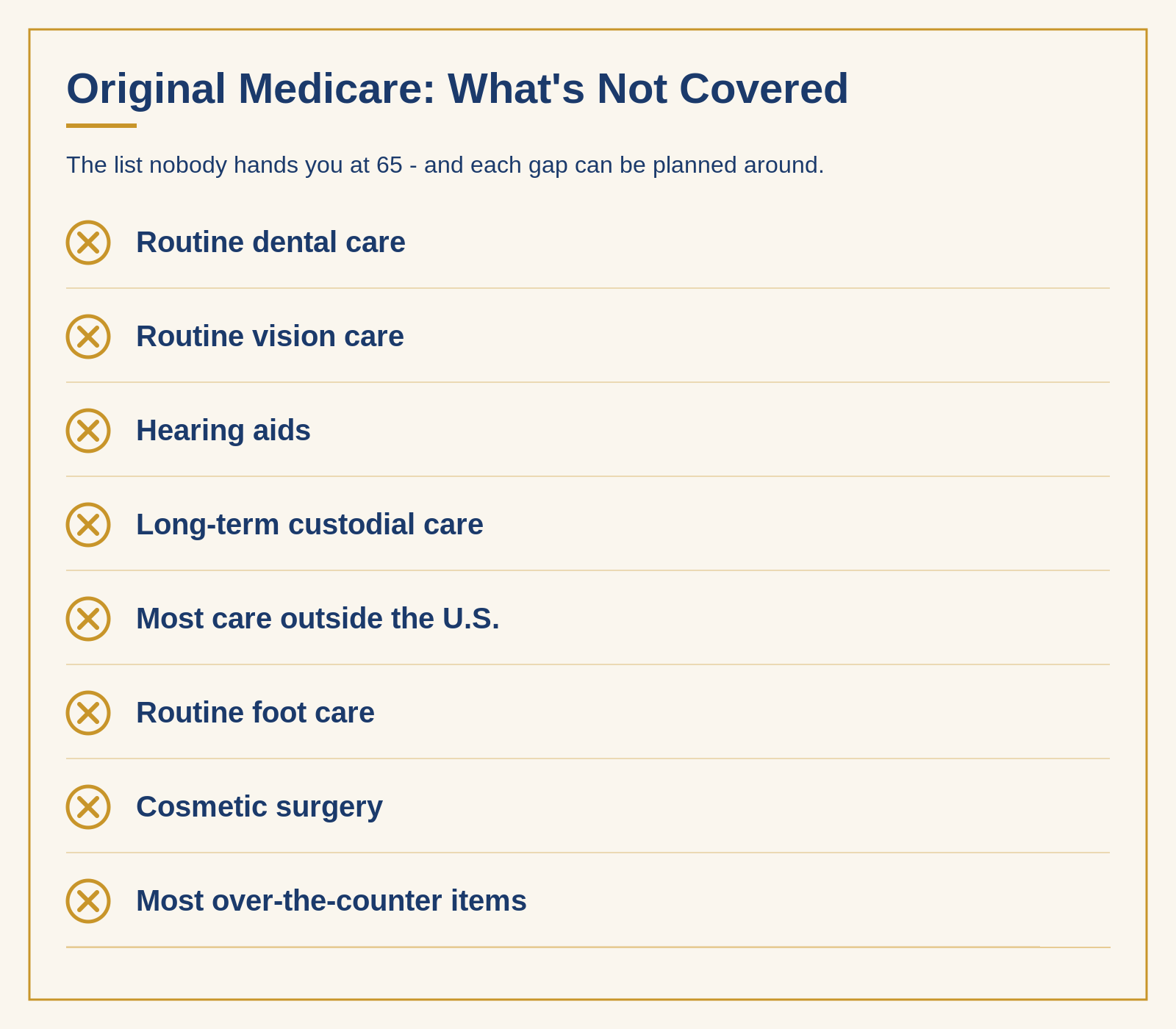
The Main Gaps
Routine dental care. Cleanings, fillings, dentures, and most dental procedures are not covered by Original Medicare. Some emergency or medically necessary dental work tied to a covered hospital procedure may be an exception, but routine dental care is not included.
Routine vision care. Eye exams for glasses, and the glasses or contacts themselves, are generally not covered. (Medicare does cover certain eye conditions and treatments, like exams related to diabetic retinopathy or cataract surgery - the exclusion is specifically for routine vision correction.)
Hearing aids and routine hearing exams. Medicare does not cover hearing aids or the exams to fit them. Diagnostic hearing tests ordered by a doctor for a medical reason may be covered - routine hearing aid fittings are not.
Long-term custodial care. This is one of the biggest and most misunderstood gaps. Medicare covers short-term skilled nursing care after a qualifying hospital stay, but it does not cover long-term custodial care - help with daily activities like bathing, dressing, and eating, whether at home or in a nursing facility, when that's the primary need rather than skilled medical treatment.
Most care outside the United States. Original Medicare generally does not cover healthcare received outside the U.S., with narrow exceptions. This is one of the reasons some Medicare Supplement plans include a foreign travel emergency benefit.
Routine foot care. Routine services like toenail trimming are typically excluded, though care related to a covered medical condition (like diabetes-related foot complications) may be covered.
Cosmetic surgery. Procedures done for cosmetic reasons rather than medical necessity are not covered.
Most over-the-counter items. Non-prescription drugs and everyday health items generally aren't covered by Original Medicare, though some Medicare Advantage plans include an over-the-counter allowance as a supplemental benefit.
Why This Catches People Off Guard
Most of these gaps aren't hidden - they're just not top of mind when people first enroll, because the enrollment process itself is focused on getting Part A and Part B set up correctly. Nobody hands you a "here's what's still not covered" sheet at the DMV or the Social Security office. By the time people run into one of these gaps, they're usually already dealing with the underlying need (a broken tooth, failing eyesight, a parent who needs daily help) - which is a much harder time to be planning from scratch.
How People Typically Plan Around These Gaps
Medicare Advantage plans often include supplemental benefits like dental, vision, and hearing coverage, and sometimes an over-the-counter allowance - the specifics vary significantly by plan.
Standalone dental, vision, and hearing plans exist separately from Medicare and can be added regardless of which path (Original Medicare or Medicare Advantage) someone chooses - see our ancillary coverage overview.
Hospital indemnity plans provide a set benefit if you're hospitalized, which can help offset costs that Original Medicare and Medigap don't fully cover. We explain how hospital indemnity works alongside Medicare Advantage in a dedicated article.
Long-term care planning is its own separate conversation - long-term care insurance, life insurance with long-term care riders, and Medicaid planning (for those who qualify) are the main paths people use, since Medicare itself isn't designed to solve this gap.
Final expense planning addresses a related but different gap: covering end-of-life costs so they don't fall on family. We cover this in a dedicated article.
The Bottom Line
None of this means Medicare falls short - it was never designed to cover everything, and understanding where the lines are drawn is what lets you plan intentionally instead of being surprised later. The goal isn't to cover every possible gap; it's to know which ones actually matter for your situation and make a deliberate choice about each one.
Want to walk through which gaps actually apply to your situation? Call the AdviseCare Insurance team at (813) 544-7066 or book a no-cost, no-obligation call. We'll help you figure out what's worth planning around.
Frequently Asked Questions
Does Medicare cover dental care?
Original Medicare does not cover routine dental care - cleanings, fillings, dentures, and most dental procedures are excluded. Some emergency or medically necessary dental work tied to a covered hospital procedure may be an exception. Some Medicare Advantage plans include dental benefits as a supplemental benefit, though specifics vary significantly by plan.
Does Medicare cover long-term care?
No - this is one of the biggest and most misunderstood gaps. Medicare covers short-term skilled nursing care after a qualifying hospital stay, but it does not cover long-term custodial care: help with daily activities like bathing, dressing, and eating, whether at home or in a nursing facility, when that's the primary need rather than skilled medical treatment.
Does Medicare cover hearing aids?
No. Medicare does not cover hearing aids or the exams to fit them. Diagnostic hearing tests ordered by a doctor for a medical reason may be covered, but routine hearing aid fittings are not.
How do people fill the gaps Medicare leaves?
Common approaches include Medicare Advantage plans with supplemental dental, vision, and hearing benefits; standalone dental, vision, and hearing plans; hospital indemnity plans that pay a set benefit during a hospital stay; long-term care planning through dedicated insurance or riders; and final expense planning for end-of-life costs. Which combination makes sense depends on your situation.
Get clear-headed Medicare guidance - once a month.
One short, useful email a month: enrollment reminders, plain-language explainers, and what's changing this year. No sales pressure. Unsubscribe anytime.
Your information stays private. We'll use it to send the newsletter and occasional helpful Medicare updates. Unsubscribe anytime.