
Final Expense Planning: A Practical Guide for Families
The short answer
Final expense planning means setting up a smaller, simplified life insurance policy dedicated to covering end-of-life costs - funeral, burial, or cremation, remaining medical bills, small debts, and family travel - so those costs don't land on the people you love during one of the hardest weeks of their lives.
Nobody enjoys planning for the end of their life. It's understandable to want to avoid the topic entirely. But final expense planning isn't really about you - it's about the people who love you, and whether they're left with a clear plan or a scramble during one of the hardest weeks of their lives.
This guide is meant to make the topic feel less heavy and more practical.
What Final Expense Planning Actually Is
Final expense planning generally refers to setting aside a dedicated, simplified life insurance policy specifically intended to cover end-of-life costs - as opposed to a larger traditional life insurance policy meant to replace income or build a broader legacy. Final expense policies are typically smaller, simpler to qualify for, and designed to be paid out quickly so the funds are available when they're actually needed.
What It's Actually For
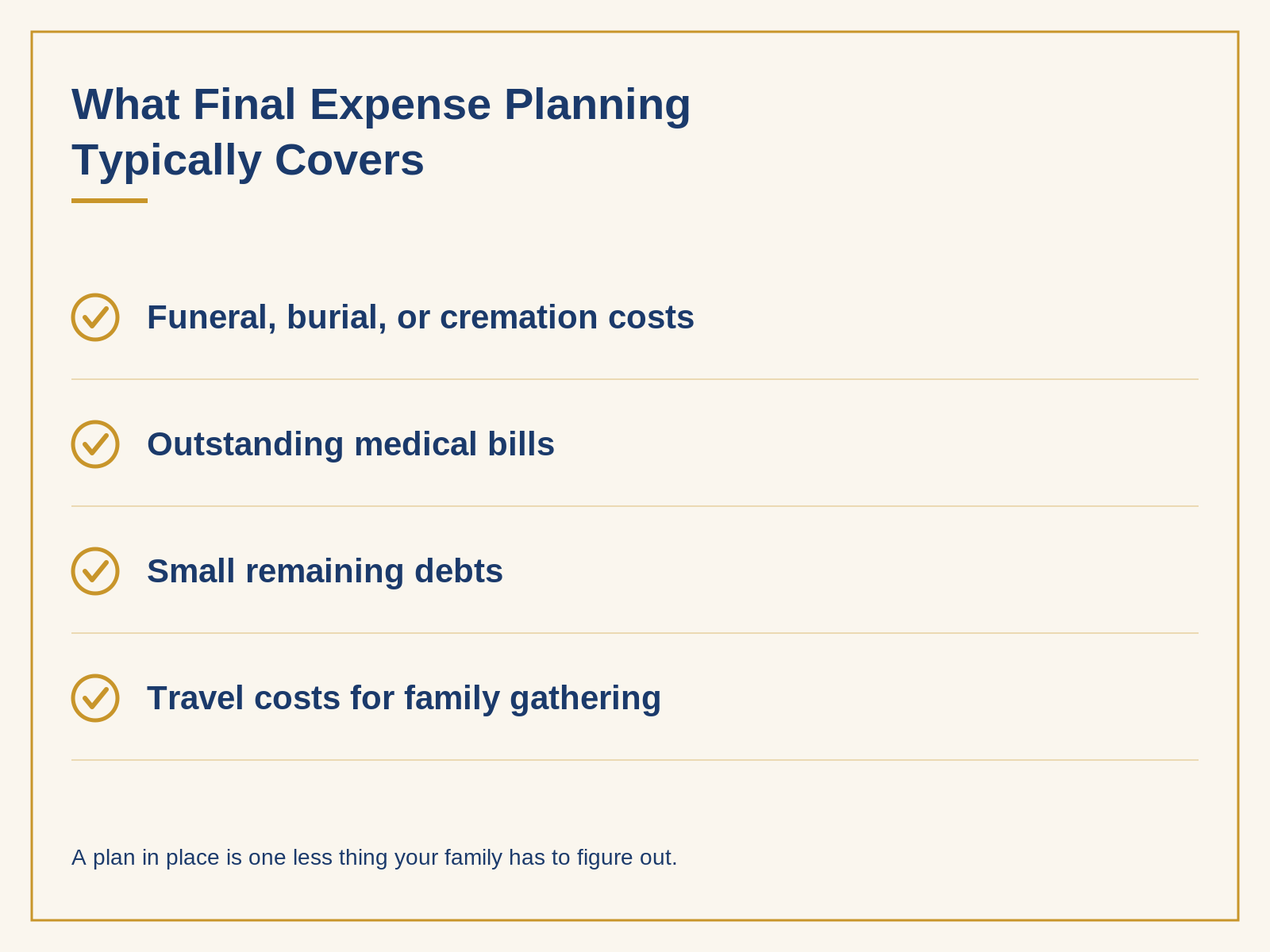
Final expense funds are typically used for things like:
Funeral, burial, or cremation costs.
Outstanding medical bills at the time of passing.
Small remaining debts.
Travel costs for family members who need to gather.
The specific costs vary enormously by family, location, and personal wishes - which is exactly why this isn't a "one-size-fits-all" number, and why we're not going to pretend otherwise with a generic price tag in this article.
Why Families Choose to Plan Ahead
The honest reason most people set up final expense coverage isn't fear - it's consideration. Without a plan in place, the financial burden of these costs typically falls on whichever family member is closest, at the exact moment they're also dealing with grief, logistics, and often other family members' needs. Having a simple, dedicated plan in place removes one entire category of stress from that moment.
It also tends to prevent a specific, common problem: family members disagreeing about how to pay for arrangements, or one person quietly absorbing a cost that should have been shared or planned for. A clear plan set up in advance sidesteps both of those situations.
How Final Expense Insurance Differs From Other Coverage
It's not the same as Medicare. Medicare does not cover funeral or burial costs. Final expense planning is a separate, private product entirely. (For the full picture of what Medicare does and doesn't cover, see What Medicare Doesn't Cover.)
It's not the same as a large traditional life insurance policy, though it serves a related purpose. Final expense policies are generally smaller and designed around simplified qualification, which matters for people who may not want or qualify for a larger traditional policy later in life.
It's not pre-paying a funeral home directly. Final expense insurance pays a benefit to whoever you designate, who can then use it for funeral costs or anything else that's needed - it's more flexible than a pre-paid funeral contract tied to one specific provider.
Questions Worth Thinking Through
Do I have a plan in place for who would handle arrangements, and would they know what I want?
Have I talked with my family about my wishes, or am I assuming they already know?
Would my family be able to cover final expenses comfortably right now, or would it be a burden?
Do I already have any coverage in place, and does it match what I'd actually want covered?
The Bottom Line
Final expense planning isn't about dwelling on mortality - it's a practical, one-time conversation that spares the people you love from having to figure out a hard problem during a hard week. Most families who've been through it without a plan in place will tell you the same thing: it's not the cost that's hard, it's the scramble.
Want to talk through what a final expense plan could look like for your family? Call the AdviseCare Insurance team at (813) 544-7066 or book a no-cost, no-obligation call. This is a calm conversation, on your timeline - no pressure.
Frequently Asked Questions
What is final expense insurance?
Final expense insurance is a dedicated, simplified life insurance policy specifically intended to cover end-of-life costs - as opposed to a larger traditional life insurance policy meant to replace income or build a broader legacy. Final expense policies are typically smaller, simpler to qualify for, and designed to be paid out quickly so the funds are available when they're actually needed.
Does Medicare cover funeral or burial costs?
No. Medicare does not cover funeral or burial costs. Final expense planning is a separate, private product entirely.
How is final expense insurance different from prepaying a funeral home?
Final expense insurance pays a benefit to whoever you designate, who can then use it for funeral costs or anything else that's needed - it's more flexible than a pre-paid funeral contract tied to one specific provider.
How is final expense insurance different from traditional life insurance?
It serves a related purpose but isn't the same. Final expense policies are generally smaller and designed around simplified qualification, which matters for people who may not want or qualify for a larger traditional policy later in life.